What the card shows
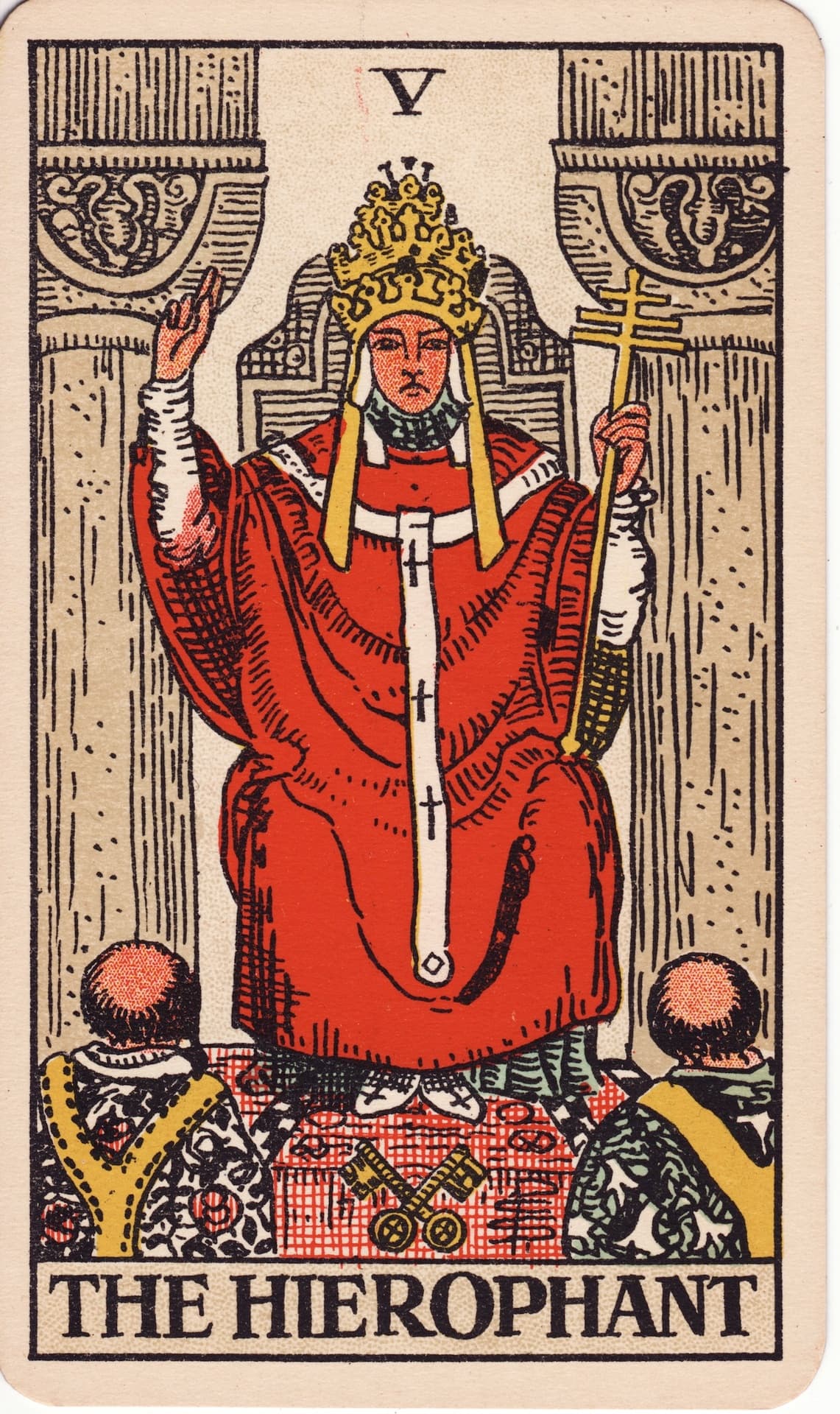
The Hierophant of the Rider-Waite-Smith deck shows a robed figure seated between two pillars, one hand raised in blessing, two crossed keys at his feet, and two tonsured figures kneeling before him.
Upright vs reversed
| Upright | Reversed | |
|---|---|---|
| Keyword | TRADITION | NONCONFORMITY |
Upright meaning
In the Rider-Waite-Smith tradition, The Hierophant is read as the card of inherited form: doctrine, mentorship, ritual, the transmission of knowledge through an institution rather than through private discovery. Waite called him the outer counterpart of The High Priestess — what she holds in silence, he speaks in established language. Practitioners often read this card as a sign that the question involves a tradition the reader is either receiving from, working within, or measuring themselves against.
The crossed keys are associated in modern RWS commentary with the authority to bind and loose teachings within a school or lineage. The two figures kneeling represent students, but also the broader idea that meaning here is mediated, not invented from scratch. As an upright card, The Hierophant is most often interpreted as a call to consult what has already been worked out — a teacher, a body of practice, a precedent — rather than to start from zero.
Reversed meaning
Reversed, The Hierophant is traditionally read as friction with inherited form: the lineage that no longer fits, the mentor whose authority has worn thin, or the reverse case — a turn toward unconventional teaching when the official channels do not serve. Waite associated the reversal with overt rebellion or with new approaches; many modern practitioners read it as a prompt to ask which inherited rules still earn the reader's loyalty and which have outlived their use.
In a reading
In a situation position, The Hierophant is often read as naming a context shaped by existing institutions, traditions, or teachers. In an action position, it is interpreted as a call to seek out structured guidance rather than improvising. In an outcome position, the card is commonly read as integration into a recognized form — or, with the reversal, a deliberate departure from it.
In combination
The Hierophant and The Fool together are read as one of the central tensions in the Major Arcana — the weight of established form against the openness of the new beginning. The tradition tends to read the combination as a question rather than a verdict: is the structure a support or a constraint? The Hierophant with The High Priestess names a related but different tension: formal teaching alongside inner knowing. When The Hierophant appears with The Lovers, the RWS tradition often reads it as the formalization or testing of a choice — the point at which what has been freely entered must be committed to or released.
Frequently asked questions
- What does The Hierophant mean in a love reading?
- In a love reading, The Hierophant most often names conventional structures around relationship — commitment, marriage, shared values, or the expectation that love will be expressed in recognized forms. The tradition reads this not as a prescription but as a description of what is operative in the situation. For some readers, the card affirms that tradition is serving the relationship. For others, it raises the question of whether the relationship is being shaped by convention in ways that need examination.
- What does The Hierophant mean in a career reading?
- In a career reading, The Hierophant names institution: the organization with its hierarchy, the certification with its requirements, the field with its established protocols. RWS practitioners often read it as a sign that working within established channels — rather than around them — is the relevant action. It can also name a mentor, a credential, or an institutional affiliation that is relevant to the question.
- What does The Hierophant reversed mean?
- Reversed, The Hierophant is traditionally read as the questioning or departure from established convention — not necessarily as rebellion, but as the recognition that the established framework is not adequate to the situation. Modern practitioners often read the reversal as a prompt to examine what has been accepted as given without sufficient scrutiny, or as permission to develop a practice or approach that is not yet sanctioned by the institutions around the reader.
These notes follow the Rider-Waite-Smith tradition. They describe what the card is associated with — not predictions about your life.