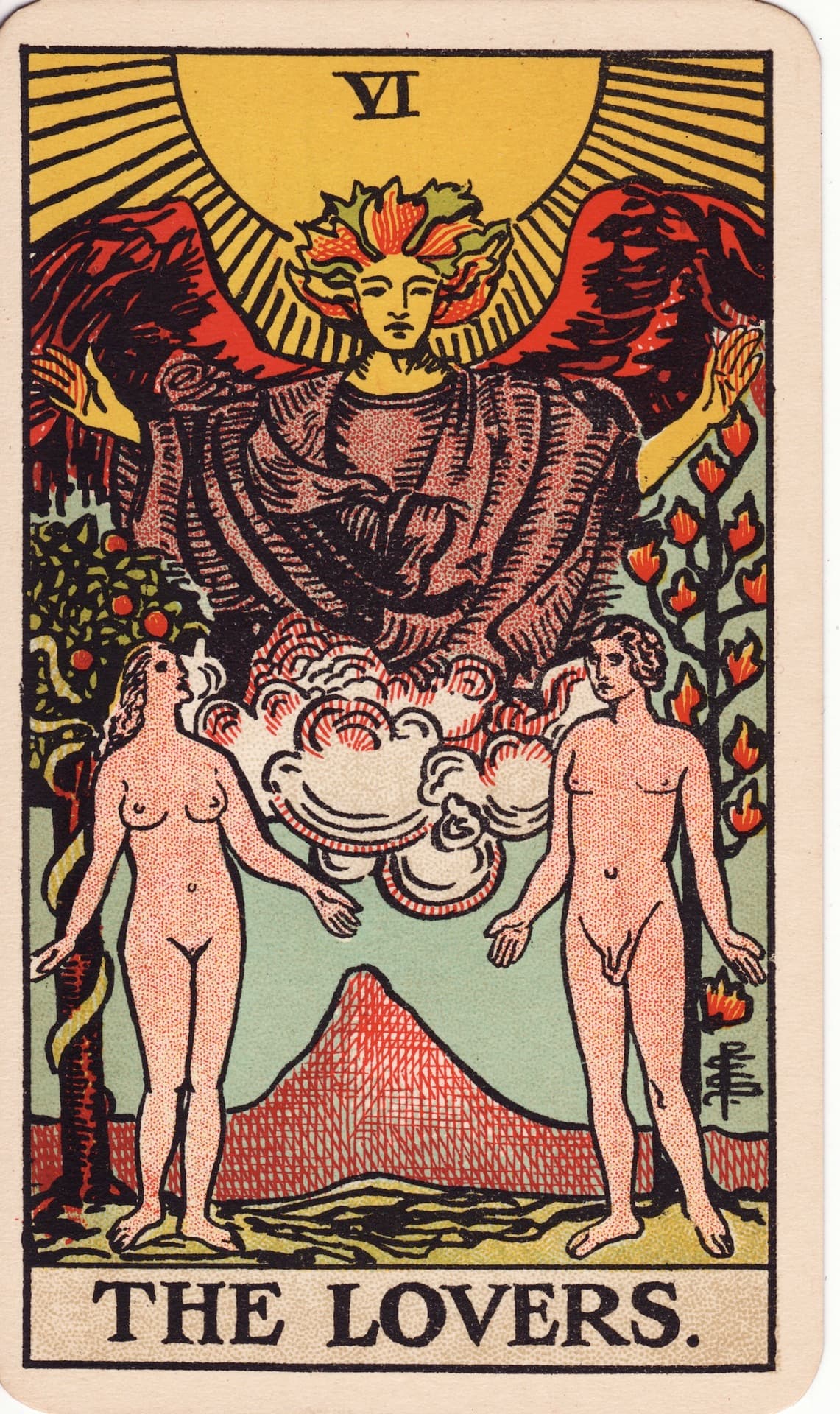
What the card shows
The Lovers of the Rider-Waite-Smith deck shows a man and a woman standing nude in a garden beneath a winged figure of light, a tree of fruit behind one of them and a tree of flame behind the other.
Upright vs reversed
| Upright | Reversed | |
|---|---|---|
| Keyword | UNION | DISHARMONY |
Upright meaning
In the Rider-Waite-Smith tradition, The Lovers is read as the card of meaningful choice in the presence of another — most often a relationship card, but more broadly the card of any decision that joins one's path to someone or something else. Waite explicitly framed the image as the figures of innocence and knowledge under a higher principle, rather than as a simple romance. Practitioners often read this card as a sign that the question concerns alignment: whether what is being chosen is in keeping with what the reader most values.
The two trees behind the figures, sometimes interpreted as the trees of life and of knowledge, anchor the card in the symbolism of decision under guidance. Modern RWS commentary tends to read the winged figure not as a deity intervening but as the higher self or principle the reader is being asked to align with. As an upright card, The Lovers is most often interpreted as a call to commit consciously rather than by drift, with full awareness of what is being chosen and what is being declined.
Reversed meaning
Reversed, The Lovers is traditionally read as misalignment between desire and value: a choice made for the wrong reason, a connection that mismatches what the reader actually wants, or a hesitation that prevents commitment in either direction. Waite associated the reversal with infidelity and rupture, but many modern practitioners read it more broadly as a prompt to examine where the question is being answered by impulse instead of by intention.
In a reading
In a situation position, The Lovers is often read as naming a moment of meaningful crossroads. In an action position, it is interpreted as a call to choose deliberately, in line with one's values, rather than reactively. In an outcome position, the card is commonly read as a union or alignment — provided the reader is willing to make the choice the card frames.
In combination
The Lovers and The Hierophant together are read in the RWS tradition as the formalization or institutional recognition of a choice — the question of whether the decision being made will be made within established structures or outside of them. When The Lovers appears with The Tower, the tradition often reads it as a significant relationship undergoing unexpected disruption — the choice made, or the alignment that existed, meeting something that forces reckoning. The Lovers with The High Priestess names the question of whether the choice is being made from the reader's deepest knowing or from surface desire.
Frequently asked questions
- What does The Lovers mean in a love reading?
- In a love reading, The Lovers is traditionally read not as confirmation of romance but as the card of a significant choice within or about a relationship. Waite's design makes the choice element central: the card is as much about a decision as it is about love itself. Modern practitioners often read it as the moment when something about a relationship must be consciously chosen — continued, deepened, ended, or redefined. In a new relationship context, it is often read as mutual recognition and genuine alignment rather than infatuation.
- What does The Lovers mean in a career reading?
- In a career reading, The Lovers is commonly read as the card of a significant choice — a fork in the professional road that will define the path forward. RWS practitioners often note that the choice the card names is not between a good option and a bad one, but between two paths that both have something to offer, making the decision genuinely difficult. The card can also name a partnership or collaboration that is central to the current situation.
- What does The Lovers reversed mean?
- Reversed, The Lovers is traditionally read as misalignment, a choice avoided, or a relationship in which the values of the two parties are not as aligned as they appear on the surface. Modern practitioners often read it as a prompt to examine what decision is being delayed, or where the reader has entered into a commitment — professional, relational, or personal — without genuinely choosing it.
These notes follow the Rider-Waite-Smith tradition. They describe what the card is associated with — not predictions about your life.