What the card shows
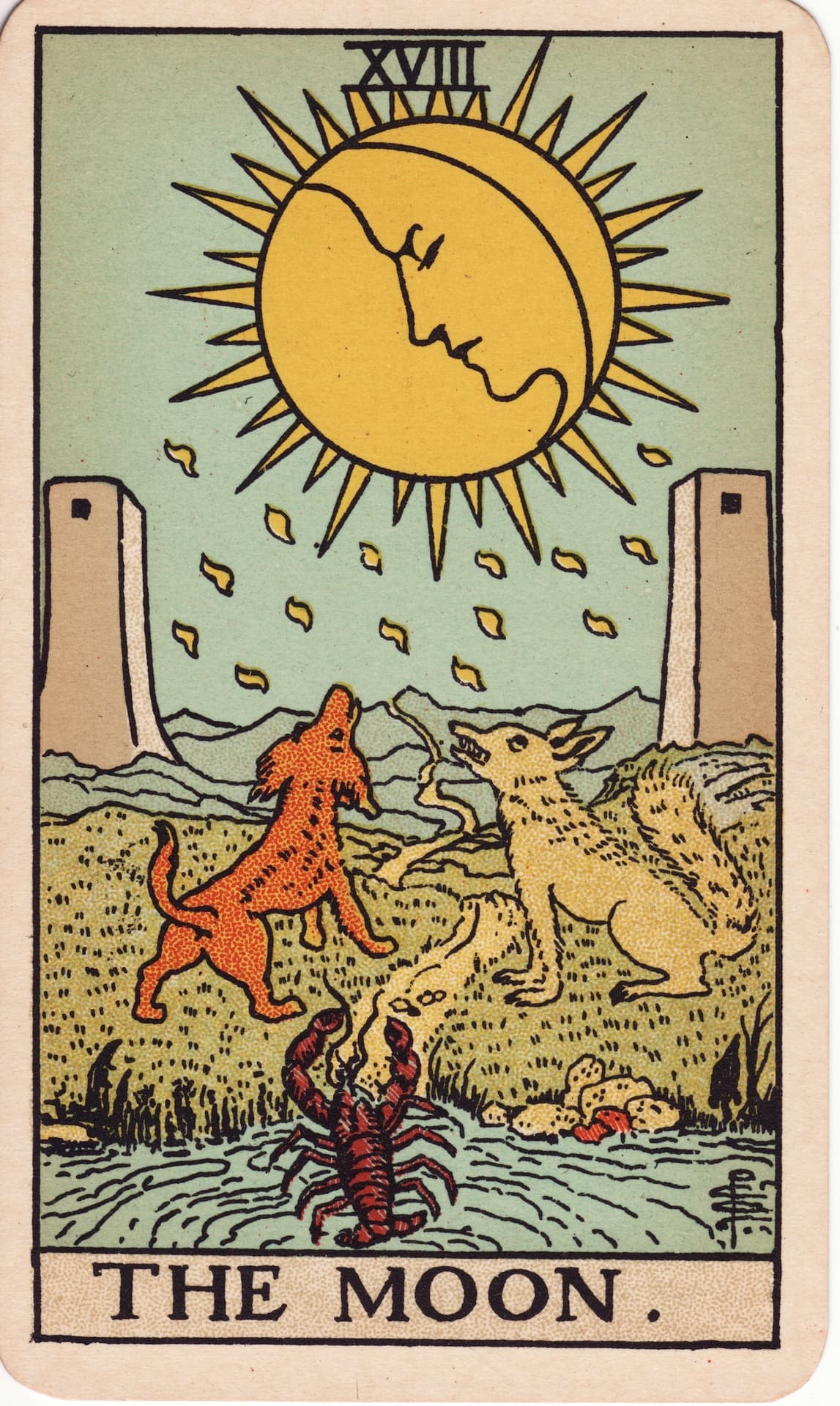
The Moon in the Rider-Waite-Smith deck shows a moon with a face above a winding path, a wolf and a domestic dog howling, a crayfish emerging from a pool, and two distant towers framing the road.
Upright vs reversed
| Upright | Reversed | |
|---|---|---|
| Keyword | ILLUSION | CLEARING FOG |
Upright meaning
In the Rider-Waite-Smith tradition, The Moon is read as the card of partial light — the territory of dreams, instincts, and old fears, where what is seen is real but not yet clearly named. Waite called the path between the towers a road that must be walked under uncertain illumination, and the crayfish emerging from the pool the tradition's image of half-formed material rising into awareness. Practitioners often read this card as a sign that the question is being asked through a fog rather than in daylight, and that what feels true now may still need the daylight of further reflection.
The wolf and the dog are associated in modern RWS commentary with the wild and the domesticated aspects of instinct, both responding to the same moon: not enemies, but parts of the same field. The Golden Dawn correspondence to Pisces grounds the card in themes of intuition, dreaming, and porous boundaries between feeling and fact. As an upright card, The Moon is most often interpreted as the counsel to walk the road carefully, to mistrust quick certainty, and to give imagined fears time to be either confirmed or dispersed by waking light.
Reversed meaning
Reversed, The Moon is traditionally read as the partial dispersal of the fog — fears named at last, illusions seen through, hidden material brought into view — or, in some readings, as the deepening of confusion when its grip has not yet broken. Waite associated the reversal with deception that becomes visible; many modern practitioners read it as a prompt to ask whether the truth that is emerging is uncomfortable enough to be ignored, and to give it credence anyway.
In a reading
In a situation position, The Moon is often read as naming a context in which not all of the relevant facts are yet visible. In an action position, it is interpreted as a call to move slowly, to honor instinct without confusing it for proof, and to wait for clearer light. In an outcome position, the card is commonly read as a phase the reader will need to pass through rather than a final resting place.
In combination
The Moon and The High Priestess together form one of the most interior and non-rational pairings in the deck — both associated with what is felt rather than known, with the signals that come from below the surface of the conscious. The combination is often read as a sign that the situation requires deep attentiveness to internal states rather than external analysis. The Moon with The Sun names the night-to-day transition: the emergence of clarity from confusion, the full illumination that follows the uncertain passage. When The Moon appears with The Hermit, the tradition often reads a call to solitary attention — the kind of careful interior work that cannot be done in company, under the uncertain light The Moon makes available.
Frequently asked questions
- What does The Moon mean in a love reading?
- In a love reading, The Moon names what is not yet conscious in the relational field — fears, projections, or aspects of the relationship that are being avoided or not yet brought to light. The tradition does not read this as a warning that the relationship is deceptive; it reads it as a recognition that something significant is operating below the surface of what is being spoken about. The card invites the reader to attend to what their quieter responses to the relationship are actually saying, before the louder ones.
- What does The Moon mean in a career reading?
- In a career reading, The Moon is most often read as a period of ambiguity and uncertainty — a professional situation in which things are not yet clear, in which what appears to be present may not be the full picture. The tradition reads this not as an instruction to distrust everyone, but as a prompt to hold conclusions lightly and to gather more information before acting. Decisions made under The Moon's influence are often revisited once the situation becomes clearer.
- What does The Moon reversed mean?
- Reversed, The Moon is traditionally read as the confusion beginning to lift — illusion losing its hold, things that were obscured beginning to become clearer. Modern practitioners often read the reversal as the transition from the nightscape toward something more illuminated, though the tradition does not promise a clean resolution: some of what is revealed when The Moon clears may still be difficult to look at.
These notes follow the Rider-Waite-Smith tradition. They describe what the card is associated with — not predictions about your life.