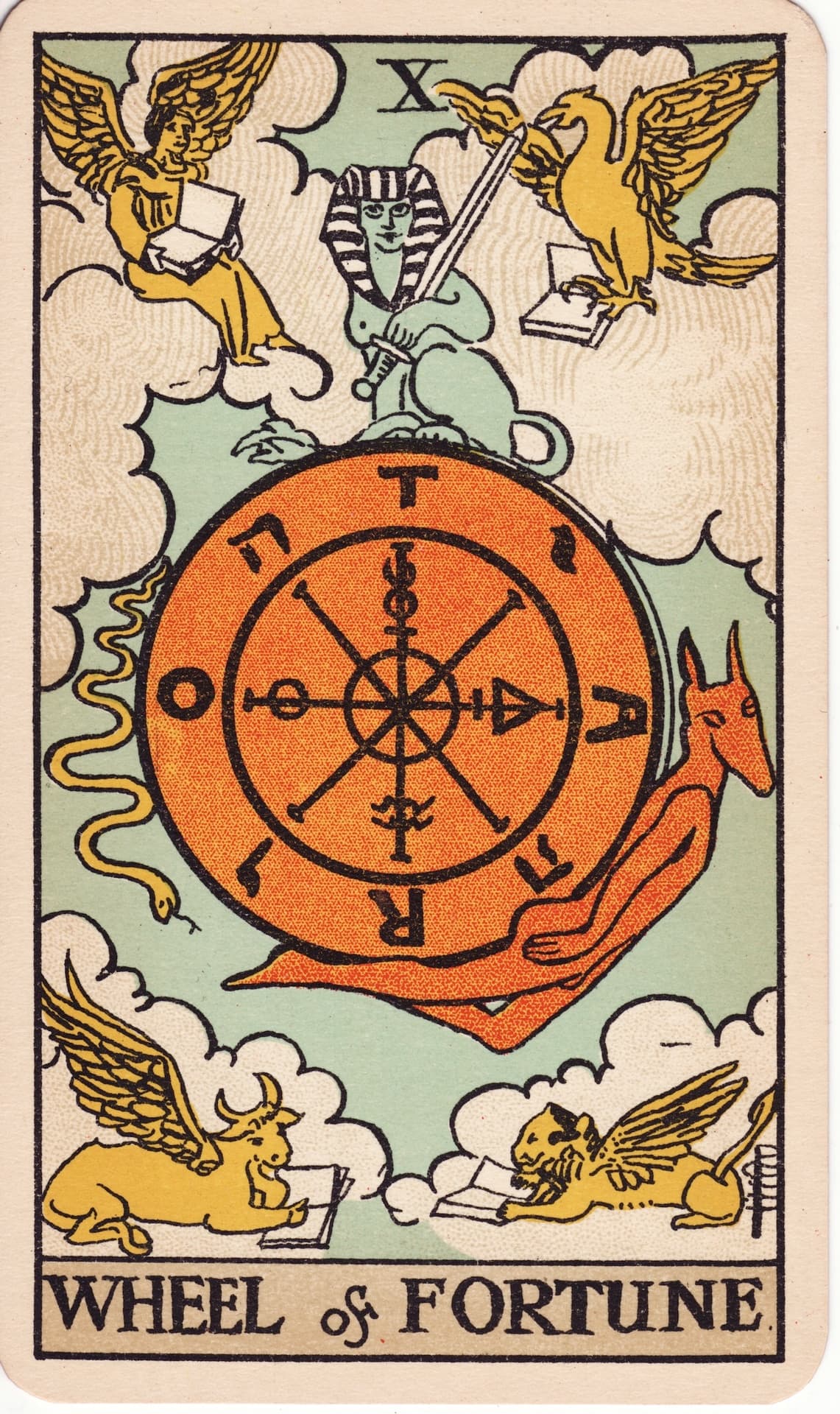
What the card shows
The Wheel of Fortune in the Rider-Waite-Smith deck shows a great wheel inscribed with letters and alchemical symbols, surrounded by four winged beings reading books — angel, eagle, lion, and bull — with a sphinx perched at the top.
Upright vs reversed
| Upright | Reversed | |
|---|---|---|
| Keyword | CYCLES | SETBACK |
Upright meaning
In the Rider-Waite-Smith tradition, the Wheel of Fortune is read as the card of cycle and turn — the recognition that the conditions of one's life are in motion, not flat, and that what comes next belongs more to the larger pattern than to any single act. Waite framed the card as a meditation on fortune in the older sense: not luck as a personal favor, but the rhythm by which situations rise and fall. Practitioners often read this card as a sign that the question is being asked at a turning point rather than in a steady stretch.
The four winged beings at the corners are associated with the fixed signs of the zodiac — Aquarius, Scorpio, Leo, and Taurus — anchoring the wheel within a stable frame even as it turns. Modern RWS commentary tends to read the card less as fatalism and more as an invitation to recognize one's place in the cycle: when something is rising, when it is cresting, when it is on its way down. As an upright card, the Wheel is most often interpreted as a shift in conditions that asks for adaptation rather than resistance.
Reversed meaning
Reversed, the Wheel of Fortune is traditionally read as the experience of being on the downward arc of the cycle, or as a stalling of the turn: events that feel stuck, momentum that has reversed, or losses that arrive without obvious cause. Waite associated the reversal with sudden drops in fortune; many modern practitioners read it as a prompt to remember that downward arcs are part of the same wheel and tend to keep turning if one does not freeze in place.
In a reading
In a situation position, the Wheel of Fortune is often read as naming a moment when the larger conditions are shifting. In an action position, it is interpreted as a call to read where one stands in the cycle and act in keeping with that, not against it. In an outcome position, the card is commonly read as a turn — a change of conditions rather than a finished verdict.
In combination
The Wheel of Fortune and The Star together are read in the RWS tradition as the turn of fortune meeting the orientation toward hope — the change that is in motion, and the inner ground that allows it to be met with openness rather than panic. The Wheel with The Tower names a more urgent combination: the cycle's turn accelerated by unexpected disruption. When The Wheel of Fortune appears with The Fool, the tradition often reads it as the classic moment of beginning: the new cycle opening, and the reader at its threshold.
Frequently asked questions
- What does The Wheel of Fortune mean in a love reading?
- In a love reading, The Wheel of Fortune is most often read as a turning point in a relationship — a shift in dynamics or circumstances that has arrived on its own rather than as the result of a specific decision. The tradition does not read the card as definitively positive or negative in love; it reads it as the recognition that something in the relational field is changing. For some readers, this names the natural deepening of a committed relationship; for others, it names the shift away from what has been.
- What does The Wheel of Fortune mean in a career reading?
- In a career reading, The Wheel of Fortune names the arrival of opportunity or change through external circumstance rather than personal initiative. The tradition reads it as the moment when the environment has shifted in a way that opens or closes what was not accessible before. Practitioners often note that this card asks less 'what should you do?' and more 'what is already in motion?' — the career turn that comes from timing rather than from effort alone.
- What does The Wheel of Fortune reversed mean?
- Reversed, The Wheel of Fortune is traditionally read as a cycle resisted or delayed — the reader fighting a natural turn, or a period in which the wheel appears to have stopped and luck to have withdrawn. Modern practitioners often read it as a prompt to examine what has been held onto past its time, or to recognize that cycles that seem to have stalled are still in motion beneath the surface.
These notes follow the Rider-Waite-Smith tradition. They describe what the card is associated with — not predictions about your life.